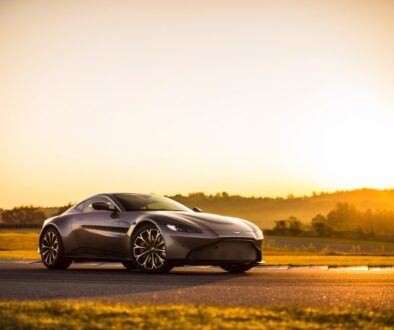

Gaydon’s marriage to Affalterbach was always going to be one that bore much fruit. When Aston Martin announced its partneship with AMG(Mercedes’ performance divison)we all hoped for the best as Mercedes’ tech know how in mass production could inject new life into Aston’s antiquated production line and values. To some this move was deemed controversial as this would mean that Aston Martin cars would be borrowing from Mercedes’ parts bin. To us, however, this move was welcome as it meant that Aston Martin cars would finally have up-to-date tech in their interiors and that the boys and girls at Gaydon could have access to Affalterbach’s finest: The AMG Engine line up.
When Aston Martin launched the DB11 there was a raft of new features bestowed upon the new flagship. The interior is all new. Gone is the old flip up sat nav and in is a new unit courtesy of Mercedes. The centre console is also bejeweled by the rotary dial and touch pad straight from Mercedes’ cars to control the infotainment system and a new instrument binnacle with a 12″ TFT LCD display.

The biggest difference with the DB11 compared to Aston’s previous offerings is the engine. An in-house twin turbo charged 5.2 litre V12 delivering 600 BHP and 700 Nm of torque. However, as a direct result of Aston Martin’s patnership with AMG, there is a smaller engine on offer. A 4.0 litre twin turbo charged V8. The same unit that powers the AMG GT line up. The choice of this engine was so as to broaden the appeal of the Aston Martin DB11 especially in terms of fuel consumption. This engine delivers 503 BHP with 675 Nm of torque and less CO2 coming out of the tail pipes.
Downsizing the DB11’s engine has lowered the top speed from 200 mph to 187 mph. The 0-100kph time is only down by a tenth compared to the V8’s bigger brother to 4.0 seconds. However, the smaller engine at the front has changed the dynamics of the car. The choice of V8 over V12 has enabled a weight saving of 115kg. Aston’s engineers have had complete freedom with the AMG derived V8 and have modified the engine accordingly. There is a new air intake, exhaust and a wet sump lubrication system in place of the standard items in AMG’s cars. There is also new software running the engine and both the engine and throttle mapping have been recalibrated to suit the DB11’s character. There are also new engine mounts in place which have enabled the engineers to mount the engine as low as possible in the car.
The car’s suspension has also been revised from the V12’s to give the car a more sporting feel compared to its big brother. The driving modes have also been changed to deliver a more agile driving experience when compared to the V12.
Aston Martin has kept the same trim levels in the V8 as the V12 which I feel is a smart move as buyers who opt for the V8 won’t feel short changed. All the options available on the V12 are also available on the V8. Visually, the only changes are new alloys for the V8, blackened surrounds for the headlamps and two bonnet slits as opposed to the four on the V12. Otherwise the two cars are identical.
The introduction of the V8 DB11 begs the question what sort of engine will power the soon-to-be-revealed Vantage range? Will it be the same two engines on offer in the GT cars but in a different state of tune? Only time will tell but I feel that that may be the most likely course of events. As for now the DB11 V8 is a very attractive proposition from Gaydon.